
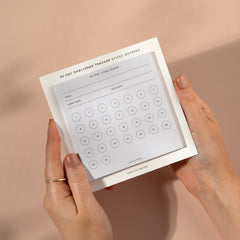
New term energy hits different. Whether you're heading into freshers' week for the first time or walking back onto campus for your final year, there's something about a fresh notebook and a clean planner that makes anything feel possible. But let's be honest, that motivation only lasts if you've actually got a system to hold onto it. That's where the right stationery comes in.
We've put together our edit of Back to Uni Essentials and practical tips using pieces from our own collection, to help you walk into lectures, seminars, and 9am starts feeling like you've actually got this.
1. Start With One Place for Everything
One of the easiest ways to make university life feel less chaotic is to give everything a home.
Lecture dates. Assignment deadlines. Study sessions. Appointments. Work shifts. Plans with friends. Even the little things you keep telling yourself you will remember.
Your planner can become the place where all of it lives.
Rather than keeping deadlines in one app, notes on your phone, reminders in another and a growing collection of screenshots, bring the important things together on paper.
A refillable ring binder planner is particularly useful for university because your planning system can change with you. Add the inserts you need, remove the pages you have finished with and create sections for different areas of your semester.
Your planner does not have to look perfectly organised.
It simply needs to make sense to you.

2. Map Out the Semester Before It Gets Busy
The beginning of term is the perfect time to look at the bigger picture.
Before weekly assignments and everyday tasks begin filling your attention, write down the dates you already know.
Think about:
- Assignment and coursework deadlines
- Exams and assessment periods
- Reading weeks
- Presentations
- Placement or internship dates
- University events
- Work commitments
- Holidays and trips
- Important personal dates
Seeing the semester on paper gives you perspective.
A deadline six weeks away can feel distant until you see everything else happening around it. Planning ahead allows you to spread the workload rather than discovering three important deadlines in the same week.
The goal is not to plan every day months in advance. It is simply to know what is coming.

3. Create a Weekly Rhythm
Once you can see the semester as a whole, bring your attention back to the week in front of you.
A weekly planner is one of our favourite tools for university life because it gives you enough structure without making every day feel overly scheduled.
At the beginning of each week, write down your fixed commitments first: lectures, seminars, work shifts and appointments.
Then add the things that need to happen around them.
Study sessions. Reading. Assignment work. Exercise. Grocery shopping. Laundry. Admin. Rest.
This creates a realistic picture of your available time.
Instead of asking, How am I going to get everything done?
You can ask, Where can this realistically fit into my week?
That small change can make a busy semester feel much more manageable.
4. Keep Your Daily Priorities Small
A long to-do list can sometimes create more overwhelm than clarity.
When everything looks important, nothing feels important.
Try choosing your three main priorities for the day instead.
These are the tasks that would make you feel satisfied if they were completed, even if everything else had to wait.
For example:
Today's priorities
- Finish research for essay
- Review lecture notes
- Submit seminar preparation
Everything else can sit underneath as additional tasks.
Planning this way helps you focus on progress rather than trying to complete an unrealistic list.
You do not need to do everything today.
You need to know what matters today.
5. Make Space for the Mental Clutter
Your planner does not only have to hold deadlines and appointments.
It can hold thoughts too.
University life comes with an enormous amount of information. Things to research, emails to send, books to find, people to contact, questions to ask and random ideas that appear while you are trying to concentrate on something completely different.
Instead of carrying all of those thoughts around in your head, write them down.
Keep a notepad beside you while studying and use it as a mental inbox.
When something pops into your mind, write it down and return to what you were doing.
You can organise it later.
Sometimes productivity is not about doing more. It is simply about giving your mind fewer things to hold onto at once.
6. Turn Big Assignments Into Small Actions
"Write dissertation."
"Finish essay."
"Revise for exam."
These may technically be tasks, but they are far too big to be useful on a daily to-do list.
When something feels overwhelming, make it smaller.
Instead of:
Write essay
Try:
Monday: Review assignment brief
Tuesday: Research three sources
Wednesday: Create outline
Thursday: Draft introduction
Friday: Write first section
Suddenly, the project has somewhere to begin.
Breaking larger projects into smaller actions also gives you something incredibly important during a demanding semester: visible progress.
7. Use Sticky Notes for the Things That Move
Not everything belongs permanently inside your planner.
Some tasks change. Some ideas evolve. Some priorities need to move from Monday to Tuesday and then, realistically, to Wednesday.
That is where sticky notepads become incredibly useful.
Use them for:
- Reading lists
- Quick reminders
- Study priorities
- Essay ideas
- Brain dumps
- Revision topics
- Questions for your lecturer
- Weekly focus lists
- Books to borrow
- Things to research later
You can move them around without rewriting an entire page.
Our Idea Edit Sticky Notepad, for example, is perfect for mind mapping an essay, brainstorming a project or taking an idea out of your head and exploring it visually.

8. Plan Your Life, Not Just Your Studies
A calm semester is not created by becoming productive every waking hour.
Your planner should contain more than coursework.
Schedule the gym class.
Write down the coffee date.
Leave an evening empty.
Plan your Sunday reset.
Make space for the things that help you feel like yourself outside of university.
When we think about planning, it is easy to focus entirely on what needs to be accomplished. But thoughtful planning should also help you protect your time.
Sometimes an empty space in your planner is not unused time.
It is breathing room.

9. Create a Simple Sunday Reset
Before a new week begins, spend ten or fifteen minutes resetting your planner.
Make a cup of tea, put your phone aside and sit somewhere comfortable.
Look at the week ahead.
What is happening?
What needs your attention?
What can wait?
What would make the week feel easier?
You might review upcoming deadlines, transfer unfinished tasks, prepare your weekly priorities and write down anything currently occupying your mind.
It does not need to become an elaborate routine.
Ten intentional minutes can completely change how Monday morning feels.

10. Keep Your Planning System Simple
There are endless productivity systems online.
Colour coding. Time blocking. Habit tracking. Morning routines. Study methods. Digital systems. Analogue systems.
You do not need to use all of them.
The best planning system is the one you actually return to.
Start with what you need right now.
Perhaps that is simply a weekly planner and somewhere to write your tasks.
Later, you might add daily pages, monthly planning, notes or additional sections.
This is one of the reasons we love refillable planning systems. Your planner does not have to stay the same throughout the year.
Your system can evolve as your life does.

Building a System That Will Last the Whole Year
Our Back to Uni Essentials
If we were building a simple university planning system from scratch, these would be our essentials:
A Ring Binder Planner
Your central home for schedules, deadlines, notes and plans. A refillable format means you can personalise your system around the way you study and organise your life.
https://fayecopapier.com/products/ring-binder-agenda-organiser-a5
Weekly Planner Inserts
See lectures, study sessions, deadlines and personal plans together in one clear weekly view.
https://fayecopapier.com/collections/planner-insert/products/vertical-weekly-planner-inserts
Daily Planner Inserts
Perfect for particularly busy days when you need more space to organise priorities, tasks and your schedule while tracking your budget and wellness.
https://fayecopapier.com/collections/planner-insert/products/minimal-daily-planner-inserts-a5
Sticky Notepads
Keep quick notes, reading lists, ideas and reminders visible without cluttering your main planner pages.
https://fayecopapier.com/collections/sticky-notes-page-flags
A Notebook
For lecture notes, journaling, brainstorming or simply having somewhere away from a screen to think.
https://fayecopapier.com/collections/lined-journals/products/classic-lined-journal
A Good Pen
Because sometimes the smallest ritual, opening your planner and putting pen to paper, is enough to make everything feel a little clearer.
https://fayecopapier.com/collections/pens
A4 Portfolio Ring Binder Organiser
For students who want something bigger-dissertations, group project files, or placement paperwork - the A4 Portfolio Ring Binder Organiser offers the same premium feel with more room to work, and it can be personalised with your initials, which makes it double up nicely as a graduation-worthy keepsake by the time finals roll around.
https://fayecopapier.com/collections/collection3/products/a4-ring-binder-organiser

There will be weeks when your planner looks beautifully organised.
There will also be weeks when you forget to open it.
There will be crossed-out plans, unfinished tasks, changing deadlines and days when productivity simply is not the priority.
That is normal.
Planning is not about controlling every part of your semester.
It is about giving yourself somewhere to return when things begin to feel noisy.
A page where you can see what matters.
A place to put the thoughts taking up space in your head.
A small analogue ritual in an increasingly digital world.
So as you head back to university this semester, you do not need to begin with an entirely new version of yourself.
Begin with a blank page.
Write down what matters.
Take it one week at a time.
And create a semester with a little more clarity, intention and room to breathe.
Here’s to a calmer semester.
Leave a comment